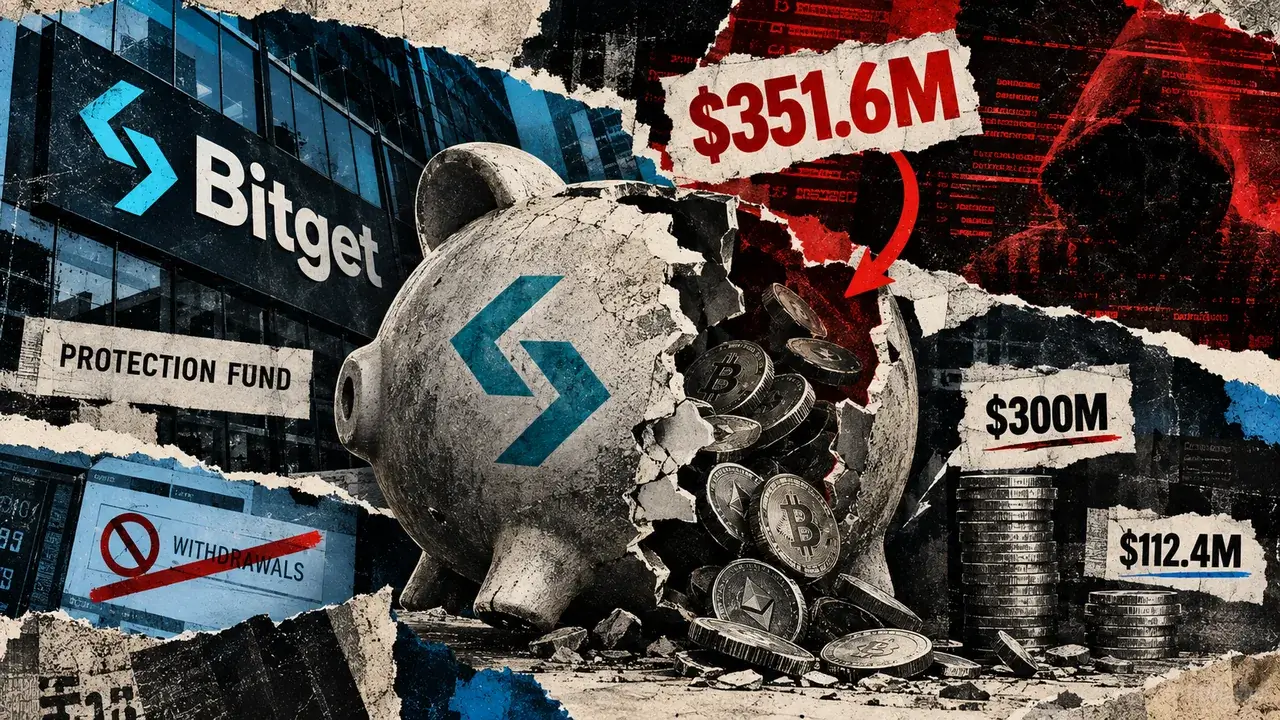
Bitget, one of Asia's largest centralized crypto exchanges, confirmed on September 25 that attackers stole approximately $352 million in digital assets — an incident investigators have linked to North Korea's Lazarus Group, and one that now threatens to consume 76% of the exchange's entire User Protection Fund.
The breach, which occurred across 19 separate transfers spanning Ethereum, XRP Ledger, BNB Smart Chain, Avalanche, Arbitrum, and stablecoin rails, represents the largest single exchange hack of 2026. For Asia-Pacific investors who hold assets on Bitget — a platform headquartered in Seychelles but operationally anchored to Asian markets — the incident is a stark reminder of a structural risk that region-specific security postures have repeatedly failed to close.
According to Bitget's post-incident disclosure, attackers gained access to a backend wallet authorization system and fabricated transfer instructions that the exchange's own signing infrastructure then processed as legitimate. The result: 19 outbound transfers across multiple chains before the anomaly was flagged. XRP suffered the single largest chain-level loss. The exchange engaged Mandiant and SlowMist for forensic investigation.
Onchain analysts quickly connected a portion of the stolen XRP to funds linked to the $24 million AFX hack in July 2026 — a data point that, combined with the attack's signature pattern, pointed investigators toward North Korea's Lazarus Group. Bitget's CEO Gracy Chen confirmed that investigators had identified IP addresses tied to VPN infrastructure previously used by the group.
Bitget's User Protection Fund held approximately $464 million — equivalent to 5,500 Bitcoin — at the time of the attack. A full $351.6 million drawdown would consume 76% of that reserve, leaving $112.4 million. The exchange has emphasized that its proprietary balance sheet exceeds $1 billion, providing a secondary backstop. Pre-attack reserve audits showed a 135% aggregate ratio across 19 tracked assets.
Bitget's user base skews heavily toward Asian retail and institutional traders, particularly in South Korea, Southeast Asia, and Chinese-speaking markets. The suspension of withdrawals — even if temporary — places those users in a familiar and uncomfortable position: assets are "safe" on paper, but inaccessible in practice during a period when markets could move against them significantly.
"The protection fund model only works if the fund itself is never seriously tested. A 76% drawdown scenario is not a stress test — it's a near-failure event." — Independent blockchain security analyst commentary circulating among Asia-based institutional desks following the incident.
The hack also arrives in the context of an escalating North Korean state-sponsored crypto theft campaign. According to UN tracking data cited by multiple analysts, North Korean groups have stolen well over $1.5 billion in crypto assets in 2026 alone — funds that flow directly into weapons programs. Asia-Pacific regulators, particularly in Singapore, South Korea, and Japan, have been coordinating responses, but the Bitget incident illustrates that operational security gaps at the exchange level remain the weakest link.
For regional investors, the incident reinforces several practical risk management principles. First, protection fund size is a lagging indicator of resilience — the architecture of the authorization system matters more. Second, multi-chain exposure amplifies single-event losses; Bitget's 19-transfer breach touched six networks simultaneously. Third, frozen withdrawal windows create second-order risks during volatile market conditions regardless of whether funds are ultimately recoverable.
Recoveries and asset freezes coordinated with law enforcement and blockchain analytics firms could reduce the actual net drawdown significantly. SlowMist and Mandiant investigations are ongoing. The final accounting — including how much of the $352 million is frozen versus laundered — will define whether the protection fund model survives this test intact or requires fundamental rethinking across Asian exchanges that have adopted similar reserve frameworks.
Keywords: Bitget hack, North Korea Lazarus Group, crypto exchange security, protection fund, Asia Pacific crypto, XRP hack, centralized exchange risk, APAC crypto regulation, blockchain security 2026
Source: CryptoSlate