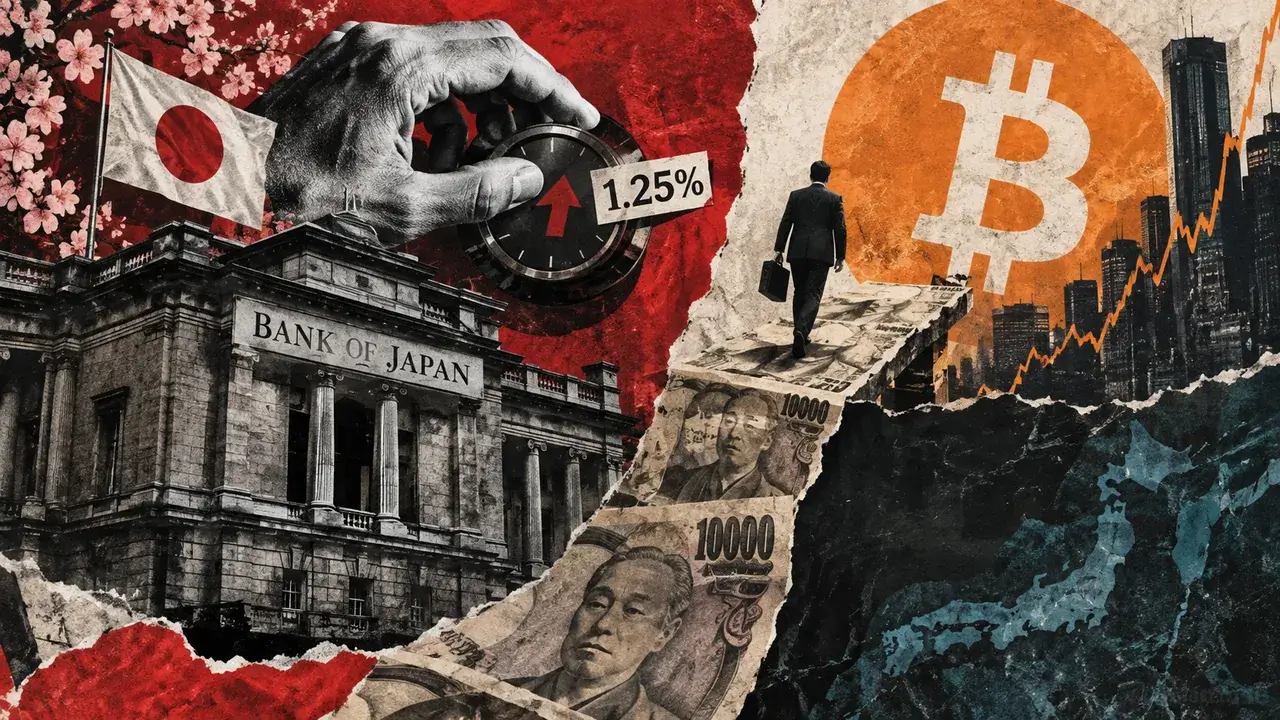
The Bank of Japan raised its benchmark overnight call rate to approximately 1.25% on September 18 — and Bitcoin climbed to an intraday high of $81,000 the same day, defying the carry-unwind fears that spooked crypto markets in 2024. The absence of a synchronized yen appreciation and risk-asset selloff suggests that immediate unwind pressure is contained. The harder test, however, begins September 24, when the new rate officially takes effect and the BOJ signals whether further tightening is on the table.
For Asia-Pacific crypto investors who lived through the August 2024 carry shock, the question is not whether yen-funded positions in risk assets exist — it is how much, and how quickly they unwind. This time, early data points to a more orderly transition. But the structural dynamic has not disappeared; it has simply been deferred.
The BOJ's policy board voted 7-2 to raise the uncollateralized overnight call rate by 25 basis points, lifting it from roughly 1.0% to roughly 1.25%. Critically, the new target and associated facility rates do not take effect until September 24. That six-day gap is significant: markets are pricing in a policy change that has not yet altered official operating rates. Positions can — and did — adjust ahead of implementation, softening the mechanical impact at the moment of the announcement.
Governor Kazuo Ueda reinforced that the BOJ is not on a fixed tightening schedule. Additional rate increases remain conditional on the bank's evolving economic and inflation outlook. That open-ended language gives markets room to speculate without a hard deadline, creating a persistent source of rate-path uncertainty through Q4 2026.
At 02:54 UTC on September 18, the moment the BOJ released its decision, Coinbase one-minute data placed Bitcoin at $76,961. By 03:30 UTC — just 36 minutes later — it had ticked up to $77,383. The rally continued through the session, reaching $81,000 intraday. That price behavior is essentially the opposite of what a disorderly carry unwind would look like.
The yen itself moved in the same non-threatening direction. Rather than surging — which would increase the cost of repaying yen-denominated borrowings and trigger forced liquidations — the currency weakened. Reuters reported the dollar rose to a two-week high of 157.84 yen during Ueda's press conference, leaving the yen roughly 1.2% softer on the day. A classic carry unwind pairs a strengthening yen with collapsing risk assets. Neither happened on September 18.
The yen carry trade works as follows: investors borrow yen at low Japanese interest rates and deploy the proceeds into higher-yielding assets — equities, bonds, or cryptocurrency — elsewhere. When Japanese rates rise, that interest-rate differential narrows, reducing the trade's profitability. If the yen simultaneously appreciates, borrowers must acquire more expensive yen to repay their loans, compounding losses on the position.
The 2024 episode demonstrated that crypto is not immune to this transmission channel. Coinbase Institutional's post-mortem on that episode noted several simultaneous catalysts — weak US economic data, pressure on technology stocks, and yen funding — which combined to amplify the drawdown. The difficulty for any market participant today is that the scale of yen-funded crypto exposure remains unquantified. There is no public registry of yen carry positions, and the BOJ's own data on cross-border borrowing lags by weeks.
"A higher Japanese rate reduces the trade's interest-rate advantage" — a structural observation that applies equally to crypto positions financed in yen and to any other risk asset in the carry stack.
Asia-Pacific traders and researchers should flag two specific warning signals as September 24 approaches and beyond:
Until either warning fires, the September 18 data supports a measured interpretation: the BOJ delivered the widely anticipated hike, markets had time to pre-position, and immediate dislocations were minimal. The accommodative language from the BOJ — financial conditions remain loose even at 1.25% — gives risk assets breathing room in the near term.
For investors based in Japan, South Korea, Singapore, and Hong Kong who hold cross-border crypto exposure, the BOJ rate path now sits alongside US Federal Reserve policy and local regulatory developments as a macro variable that warrants active monitoring. Japanese corporate Bitcoin buyers — several of whom have disclosed BTC treasury positions in recent months — face a structural headwind as yen borrowing costs rise, even if their existing fixed-rate obligations are unaffected in the short term.
The broader takeaway: the September 18 reaction was encouraging, but it reflects a pre-implementation rally, not a post-implementation all-clear. The real stress test runs from September 24 onward, as higher funding costs become operational and the BOJ's next communication window approaches. Regional investors who dismissed the carry channel after the orderly initial reaction may want to revisit that assumption before month-end.
Keywords: Bank of Japan, BOJ rate hike, yen carry trade, Bitcoin rally, Japanese monetary policy, crypto macro risk, yen-funded positions, Asia-Pacific crypto
Source: CryptoSlate