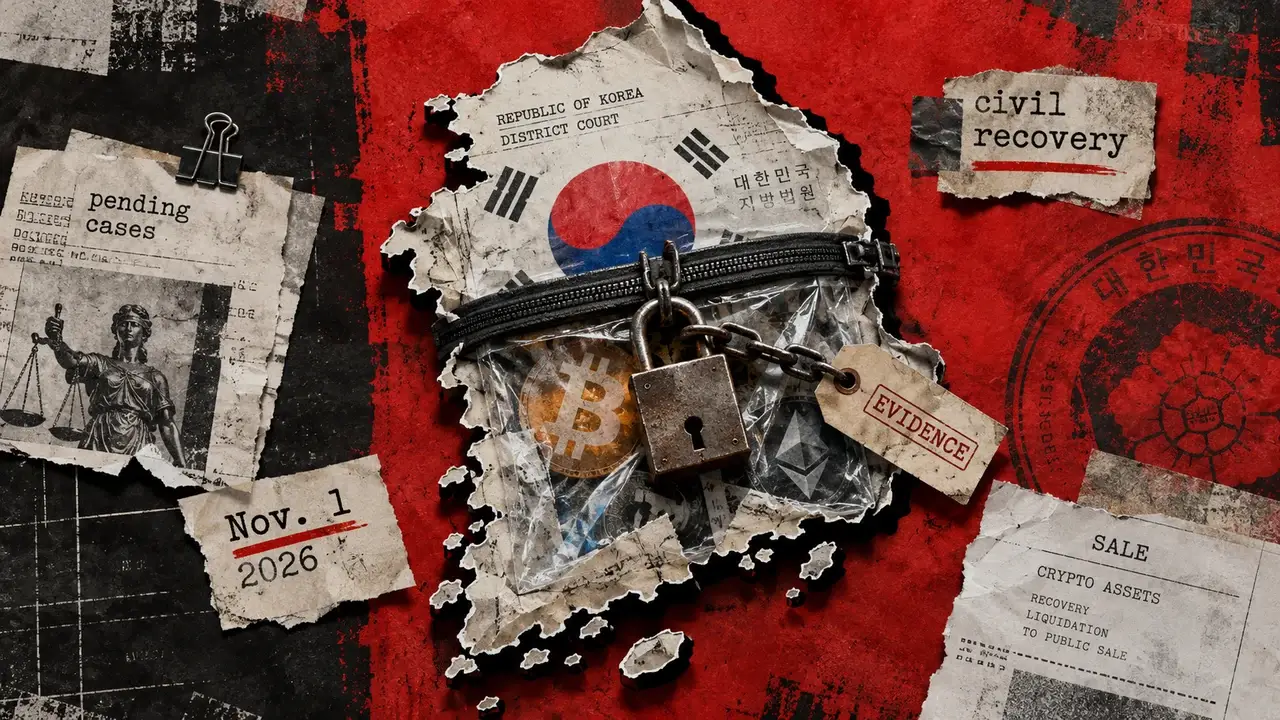
South Korea's Supreme Court has handed creditors a powerful new tool: starting November 1, 2026, courts can freeze, seize, and sell a debtor's cryptocurrency — including assets held in private wallets — to settle civil debt obligations. Rule 3280, announced October 12, creates the first standardized legal framework for digital-asset enforcement in South Korea and signals a watershed moment for crypto's legal status across the Asia-Pacific region.
Rule 3280 does three things that matter to investors. First, it gives court enforcement officers authority to take possession of directly-held cryptocurrency before a debtor is formally notified of an attachment order. That pre-notification window closes the most obvious escape route — moving funds to another wallet the moment legal papers arrive.
Second, the rule obligates exchanges and custodians to act immediately when served a court order. Once notified, a custodian must block the debtor from transferring or disposing of their holdings and, within seven days, disclose full details: the types and quantities of crypto held, whether the debtor has recognized claims, and any competing creditor priorities.
Third, courts gain discretion over how seized crypto is liquidated. Judges can authorize sales through the existing custodian, transfer to enforcement-officer-controlled accounts, or conversion into more liquid assets — all at prevailing market prices on the transaction date.
South Korea consistently ranks among the top five countries globally for crypto trading volume. The country's leading exchanges — Upbit, Bithumb, Korbit, and Coinone — collectively serve millions of retail accounts. Introducing court-ordered liquidation into that ecosystem changes the risk calculus for anyone who holds crypto in South Korea, whether as a primary investment or as collateral in a business dispute.
South Korea's move reflects a broader Asia-Pacific trend of embedding crypto assets into mainstream civil and commercial law rather than treating them as a regulatory grey zone. Japan has already recognized crypto as property under the Payment Services Act. Singapore's Monetary Authority has implemented clear licensing tiers for digital asset service providers. Hong Kong launched its licensed exchange regime in 2023 and has since expanded it to cover retail investors.
What sets Rule 3280 apart is its granularity. Rather than a broad declaration that "crypto is property," South Korea has written court-ready enforcement procedures — covering disclosure timelines, liquidation methods, debtor appeal rights, and restoration processes. That level of operational detail typically signals a jurisdiction that intends to enforce, not just legislate.
"The amendment aims to improve legal certainty and consistency in cryptocurrency enforcement." — South Korean Supreme Court, October 12, 2026
For retail and institutional investors with Korean exchange accounts, the practical exposure is limited — creditors still need a legitimate civil judgment before any seizure order can be issued. The rule does not give creditors unilateral power to freeze accounts. However, the risk of holding large balances on-exchange while involved in any South Korean civil dispute has materially increased.
The harder enforcement question concerns self-custodied assets. Rule 3280 allows courts to order delivery of privately held crypto to enforcement officers, but the mechanism depends on the debtor voluntarily providing private keys or seed phrases. If a debtor refuses or claims the keys are lost, enforcement becomes a contempt-of-court issue rather than a technical one — a gap South Korean courts will likely need to address in subsequent rulings.
For regional compliance teams, the November 1 deadline is a hard line. Korean exchanges and custodians that have not updated their legal-hold and disclosure workflows by then face immediate exposure the moment a court order lands. Investors trading on Korean platforms should expect platforms to begin communicating these procedural changes in the weeks ahead.
Keywords: South Korea, crypto seizure, Bitcoin, court enforcement, Asia-Pacific regulation, Rule 3280, debt recovery, digital assets
Source: CryptoSlate