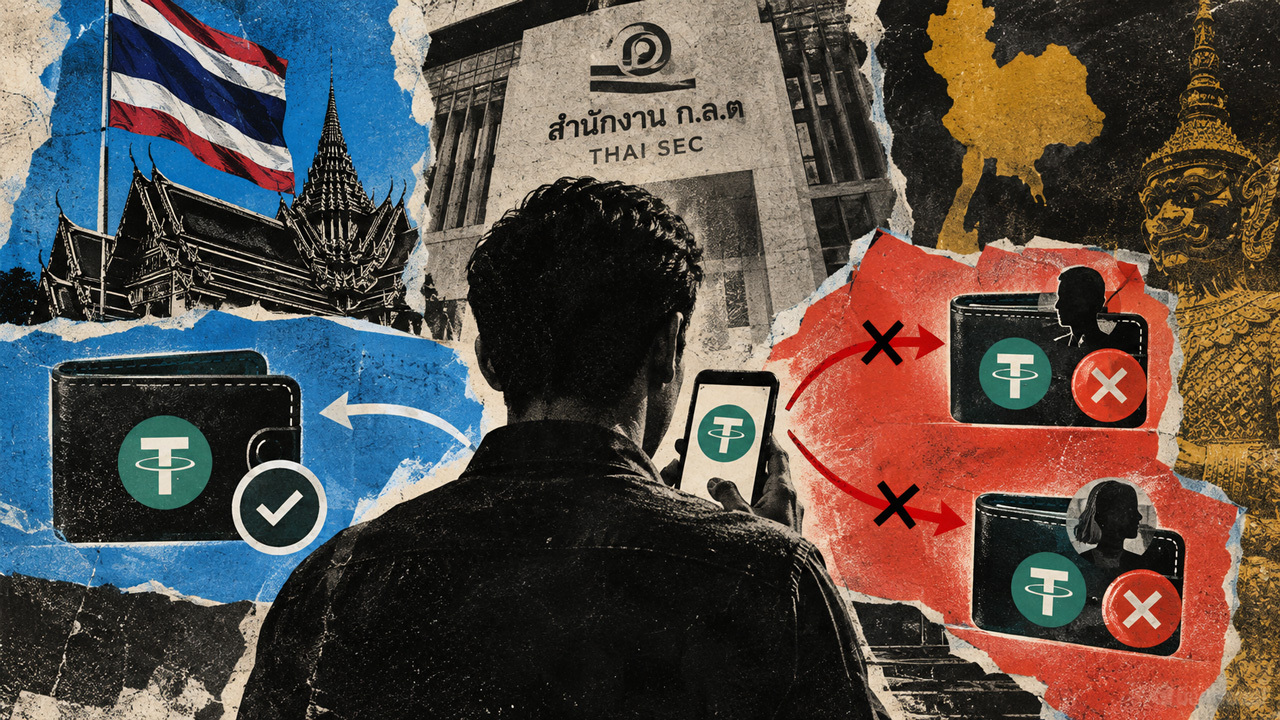
Thailand's Securities and Exchange Commission has proposed one of the most restrictive stablecoin transfer regimes in the Asia-Pacific region: a same-owner requirement that would prohibit customers from sending or receiving USDT — or any stablecoin — through a licensed platform unless the counterparty wallet is verified as their own. Still at the consultation stage with comments due September 25, the proposal signals a decisive regulatory posture that compliance officers across the region cannot afford to ignore.
The structural implication is unambiguous. If enacted as drafted, Thailand's SEC would effectively convert licensed digital asset operators into closed-loop custodians — platforms through which stablecoins can only travel between a single user's own verified accounts. Third-party transfers, a routine feature of corporate treasury operations, OTC settlement desks, and cross-border remittances, would become prohibited acts within the supervised perimeter. The rule does not touch peer-to-peer transactions executed entirely outside licensed venues, but that carve-out offers limited comfort to institutional participants whose counterparties sit inside the regulated system.
Thailand's approach must be read against the backdrop of its forthcoming Travel Rule implementation, scheduled to take effect February 27, 2027. That rule already requires digital asset operators to collect sender and recipient information, screen counterparties, and verify ownership or control of self-hosted wallets. What the September 3 SEC Board consultation adds is categorically stricter: the Travel Rule demands information collection; the stablecoin ownership proposal demands verified identity alignment between customer and counterparty. These are not duplicative — they operate in sequence, with the ownership test functioning as a hard gate that Travel Rule compliance alone cannot satisfy.
The SEC cited two evidentiary bases for the proposal: a documented surge in stablecoin transaction volume and value — with USDT explicitly named — and observed patterns it associates with money laundering risk, cybercrime proceeds, and circumvention of international remittance controls. This framing mirrors the Financial Action Task Force's 2023 updated Recommendation 16 guidance on virtual asset travel, suggesting that Thailand is positioning itself within the FATF-compliant mainstream rather than innovating in isolation. Compliance teams in Hong Kong, Singapore, and Japan, jurisdictions that have wrestled with the same FATF obligations, will recognise the regulatory logic even if they have not adopted the same instrument.
Alongside the ownership test, the consultation introduces a 5 million baht per-person, per-operator, per-day cap on both inbound and outbound stablecoin transfers — equivalent to roughly USD 145,000 at current rates. That ceiling is not trivial for retail participants, but it is operationally constraining for institutional flows. The exemption architecture is therefore critical:
What remains unresolved is whether cap exemptions also relax the same-owner test, or whether the two requirements operate independently. The consultation document does not settle this point, and the SEC has not announced an effective date. That ambiguity is precisely where implementation risk concentrates: firms that assume the cap waiver removes the ownership obligation may find themselves non-compliant once final rules are published.
A same-owner transfer requirement at the licensed operator perimeter is structurally equivalent to prohibiting third-party settlement through a bank correspondent account — it forces every institutional use case to route through bilateral agreements or go off-platform entirely.
For institutional investors and compliance professionals operating across the Asia-Pacific arc, Thailand's proposal raises several immediate strategic considerations. First, any firm using a Thai-licensed platform as part of a cross-border stablecoin settlement chain would face a structural compliance break under the proposed rule. Second, corporate treasury teams using stablecoins for inter-company transfers would need to ensure all participating accounts are co-registered to the same entity. Third, the proposal creates an asymmetry between on-platform and off-platform stablecoin liquidity that may accelerate migration of large-volume flows to unregulated venues — the precise outcome regulators are trying to prevent.
Comparable frameworks in the Asia-Pacific region illuminate what Thailand is navigating. Japan's FSA has concentrated its stablecoin framework on issuance requirements under the 2023 Payment Services Act amendments rather than transfer restrictions. Singapore's MAS took a risk-based approach under the Stablecoin Regulatory Framework effective August 2023, focusing on reserve backing and single-currency issuance conditions. South Korea's FSC, still consolidating its Virtual Asset User Protection Act infrastructure post-July 2024 implementation, has not yet introduced transfer-side restrictions of this specificity. Thailand's proposal would, if finalised in its current form, make the Thai SEC the first major Asia-Pacific regulator to impose a hard same-owner test at the operator transfer boundary.
The public consultation closes September 25, 2026. Industry participants with exposure to Thai-licensed platforms should prioritise three areas of engagement: clarifying the relationship between the same-owner test and the cap exemptions for Travel Rule-compliant inter-operator transfers; seeking guidance on how corporate entities with multiple verified accounts will be treated under the ownership verification requirement; and requesting an explicit transition timeline to allow operational restructuring. The SEC's response to these points will determine whether the final rule reflects a proportionate anti-money-laundering instrument or a blunt instrument that displaces legitimate institutional activity without addressing the underlying risk vectors.
Keywords: Thailand SEC, stablecoin regulation, USDT, Travel Rule, Asia-Pacific crypto policy, KYC compliance, digital asset operator, money laundering
Source: CryptoSlate